SMPTE ST 2110: The IP Standard Transforming Professional Broadcast — And the Hardware That Makes It Real
A complete guide to SMPTE ST 2110, why it matters for your facility, and the leading AJA and Matrox products that bring IP video to life.
What Is SMPTE ST 2110?
The broadcast industry is in the middle of its most significant infrastructure shift in decades. After more than thirty years of Serial Digital Interface (SDI) dominance, facilities around the world are replacing copper cables and rigid topologies with something far more powerful: IP networks. At the heart of that transition is SMPTE ST 2110 — a suite of standards that defines exactly how professional video, audio, and ancillary data should travel across an IP network in real time.
Developed by the Society of Motion Picture and Television Engineers (SMPTE) and first published in November 2017, ST 2110 was the culmination of years of industry collaboration involving the Video Services Forum (VSF), the Advanced Media Workflow Association (AMWA), and the European Broadcasting Union (EBU).
The Core Idea: Separate Essence Streams
Traditional SDI combines video, audio, and metadata into a single serial stream over a coaxial cable. If you need to route the audio separately from the video, you have to break and re-embed the signal at every step — costly, inflexible, and operationally complex.
SMPTE ST 2110 takes the opposite approach. Video, audio, and ancillary data are transported as independent essence streams over standard Ethernet using the RTP/UDP/IP stack. Each stream carries its own timing information, and synchronisation across all streams is maintained by the Precision Time Protocol (PTP / IEEE 1588). This separation unlocks a new level of operational flexibility that simply was not possible with SDI.
The Key Standards in the ST 2110 Suite
The suite is made up of several complementary documents, each addressing a specific aspect of IP media transport:
ST 2110 vs. SDI: Why the Industry Is Moving
The transition from SDI to ST 2110 represents a fundamental rethinking of how broadcast infrastructure is designed and operated. Here is why facility engineers and broadcast managers across the Middle East and beyond are making the move:
- Scalability without physical limits: Adding channels in SDI means adding cables and dedicated hardware. With ST 2110, adding or re-routing a signal is a software operation on a standard IP network.
- Multi-point distribution: IP supports both unicast and multicast, meaning a single signal source can be sent simultaneously to many destinations with no additional hardware.
- Flexibility and reconfigurability: A software-defined network can be reconfigured in seconds — switching cameras, re-routing feeds, or adapting to a new studio layout.
- Future-proof for 4K and 8K: ST 2110's ability to carry streams across 25 GbE, 100 GbE, and beyond means the infrastructure can grow with the technology.
- IT ecosystem integration: Works with standard Ethernet switches and monitoring tools, enabling broadcast facilities to benefit from decades of IT innovation.
- Interoperability via NMOS: Open APIs for device discovery (IS-04) and connection management (IS-05) mean equipment from different manufacturers works through a common software interface.
Key Technical Concepts for Engineers
Precision Time Protocol (PTP)
PTP (IEEE 1588-2008 / SMPTE ST 2059-2) is the timing backbone of every ST 2110 installation. A Grandmaster Clock distributes sub-microsecond timing across the network, ensuring that a video frame received at one end of a facility is perfectly aligned with its corresponding audio and metadata streams.
NMOS IS-04 and IS-05
NMOS IS-04 allows devices to register on a central registry for software discovery. IS-05 provides a standardised way to make and break connections between sources and receivers — effectively a software patch bay for the entire IP facility.
ST 2022-7 Seamless Protection Switching
For mission-critical applications, ST 2022-7 provides hitless redundancy. Two identical streams are sent over separate network paths; the receiver seamlessly switches between them if packet loss occurs on either path — with no visible glitch.
JPEG XS and ST 2110-22
JPEG XS delivers visually lossless quality with latency measured in milliseconds, making it the compression standard of choice for ST 2110-22 implementations that need to traverse WAN links for remote production workflows.
ST 2110 Solutions Available Through Mediasys
Mediasys has been the authorised distributor for AJA Video Systems and Matrox Video in the Middle East for over 20 years. Through those two partnerships, we represent the most comprehensive portfolio of SMPTE ST 2110 hardware available in the region — from PCIe capture cards and IP converters to professional KVM extenders and signal routing tools.
Whether you are building a greenfield IP facility, migrating an existing SDI infrastructure to hybrid IP, or integrating ST 2110 feeds into your creative workstation environment, Mediasys can supply, configure, and support the right solution for your project.
AJA Video Systems — ST 2110 Products
AJA Video Systems has been engineering professional video hardware since 1993. Their ST 2110 product line reflects the same philosophy that has made the KONA card family a fixture in broadcast facilities worldwide: reliable, standards-compliant hardware that integrates transparently into the workflows engineers already rely on.
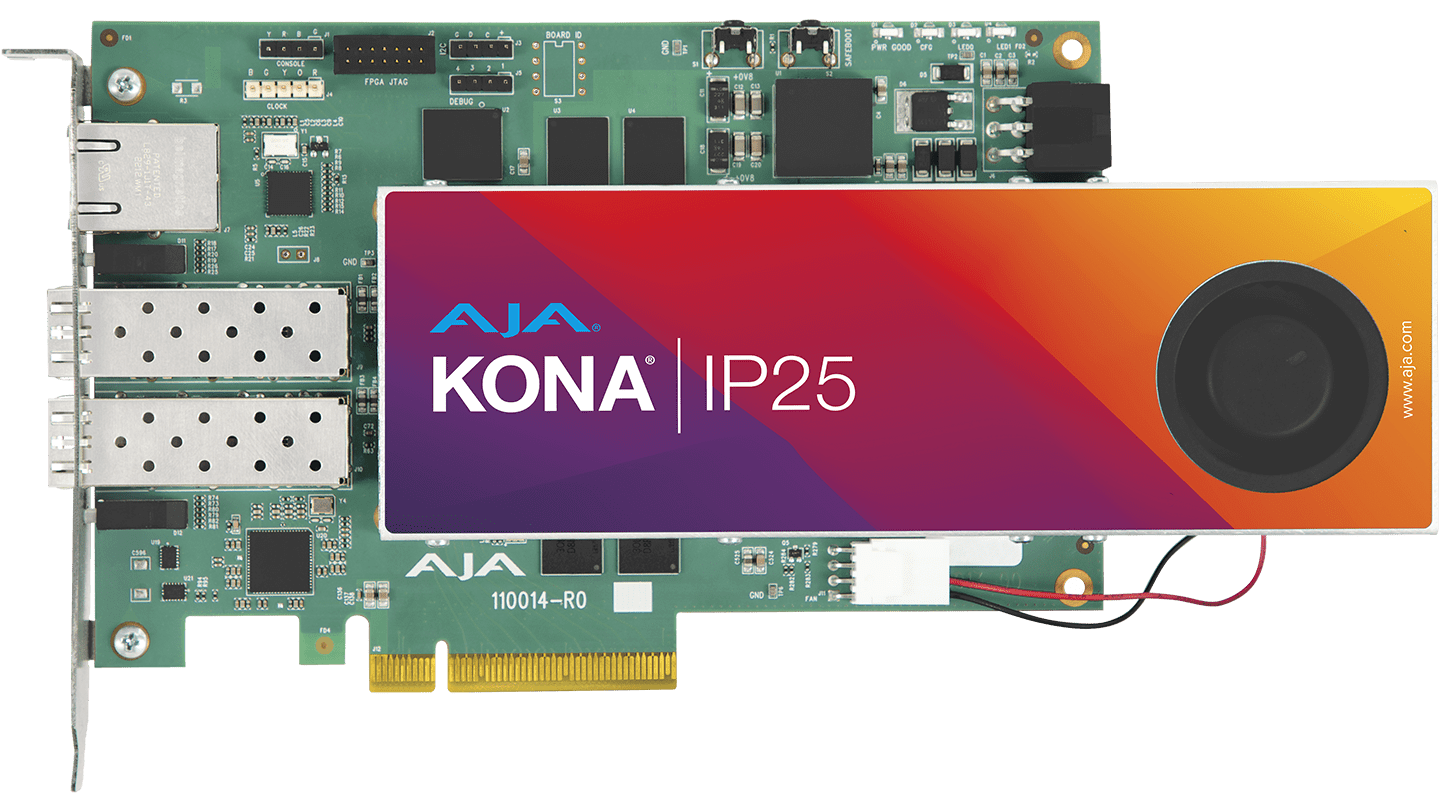
- 8-lane PCIe Gen 4.0 card with dual 10/25 GigE SFP28 cages for ST 2110 media transport
- Supports uncompressed ST 2110-20 video up to 4K/UltraHD 59.94/60p over dual 25 GbE
- Full suite compliance: ST 2110-10, -20, -21, -23, -30, -31, -40, plus ST 2022-7 hitless redundancy
- Onboard PTP (PTPv2) and NMOS (IS-04, IS-05) — all ST 2110 processing on the card, not the host CPU
- In-Band (via SFPs) and Out-of-Band (via RJ-45) control options
- Compatible with Adobe Premiere Pro, Avid Media Composer, Apple Final Cut Pro, and AJA Control Room
- AJA NTV2 SDK support for developer integration
- Ideal for: broadcast ingest/playout, post production, live production trucks, studio workstations
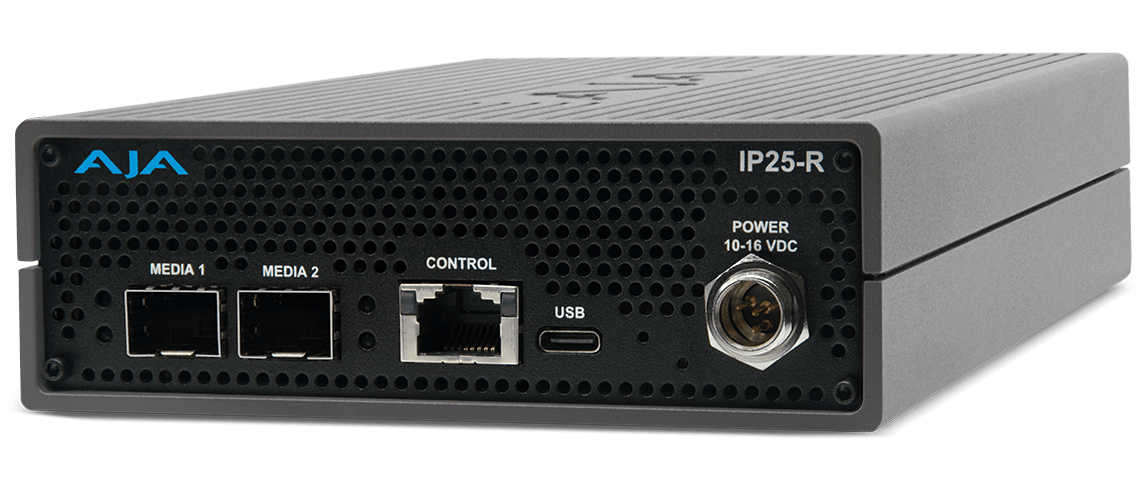
- Converts incoming SMPTE ST 2110 IP video to baseband SDI and HDMI outputs
- Supports video up to 4K DCI (4096×2160p60) — uncompressed, ultra-low latency
- 4× 12G-SDI BNC outputs and 2× HDMI 2.0 outputs from a single compact enclosure
- Dual SFP28 cages for ST 2022-7 seamless protection switching across redundant IP networks
- Up to three units mountable side-by-side in 1RU; six units in 3RU DRM2-Plus frame with redundant power
- Front USB-C port for initial network configuration via AJA eMini-Setup
- Ideal for: hybrid SDI/IP facilities, signal monitoring, stadium workflows, machine rooms
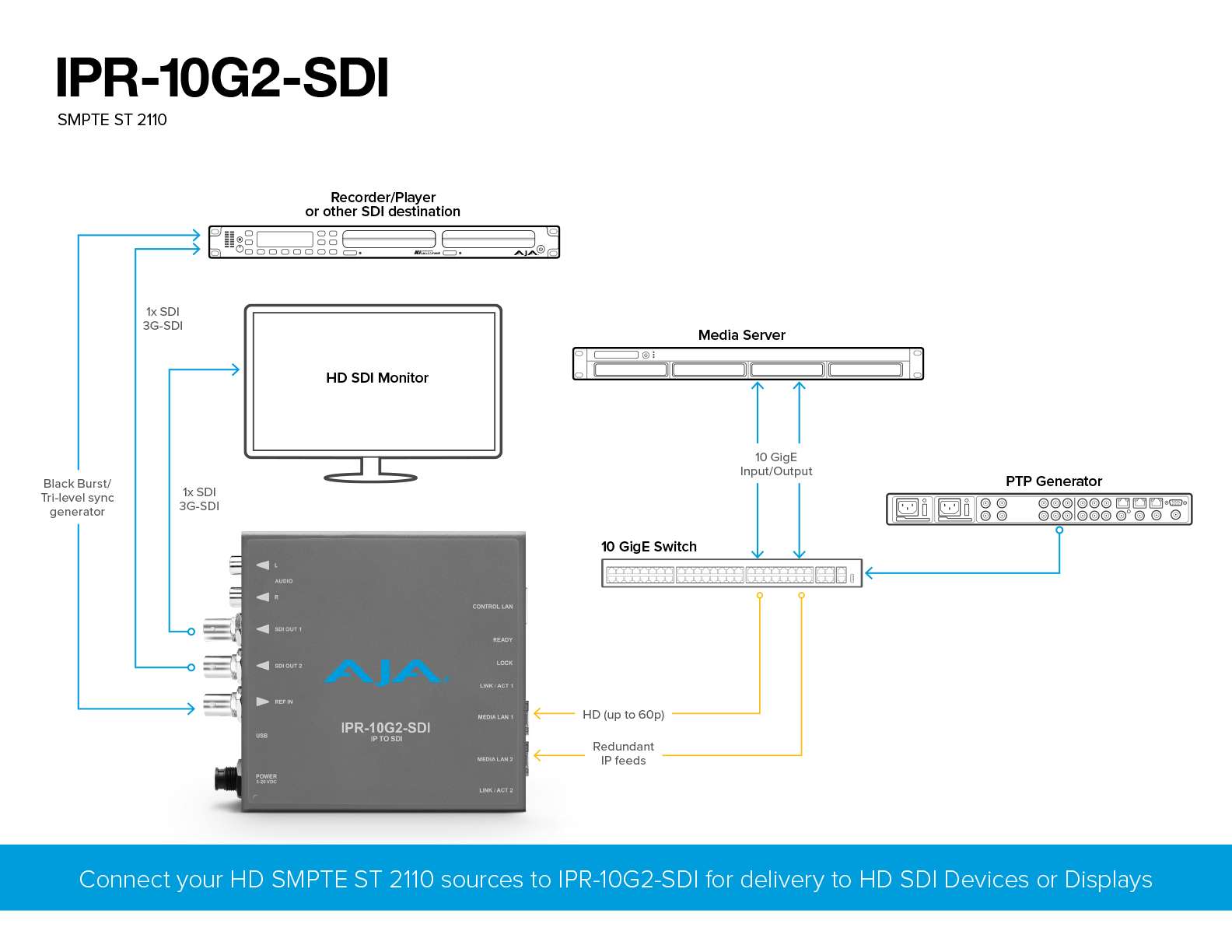
- Receives ST 2110 video and audio over 10 GbE and outputs baseband 3G-SDI up to HD 60p
- Dual 10 GbE SFP+ cages for ST 2022-7 hitless switching redundancy
- Integrated audio extraction, synchronisation, and embedding into SDI output
- Simultaneous analog stereo audio output via dual RCA connectors
- Web browser-based control interface; mini-USB for initial configuration via eMini Setup
- Ideal for: point-of-use monitoring, SDI device integration in IP facilities
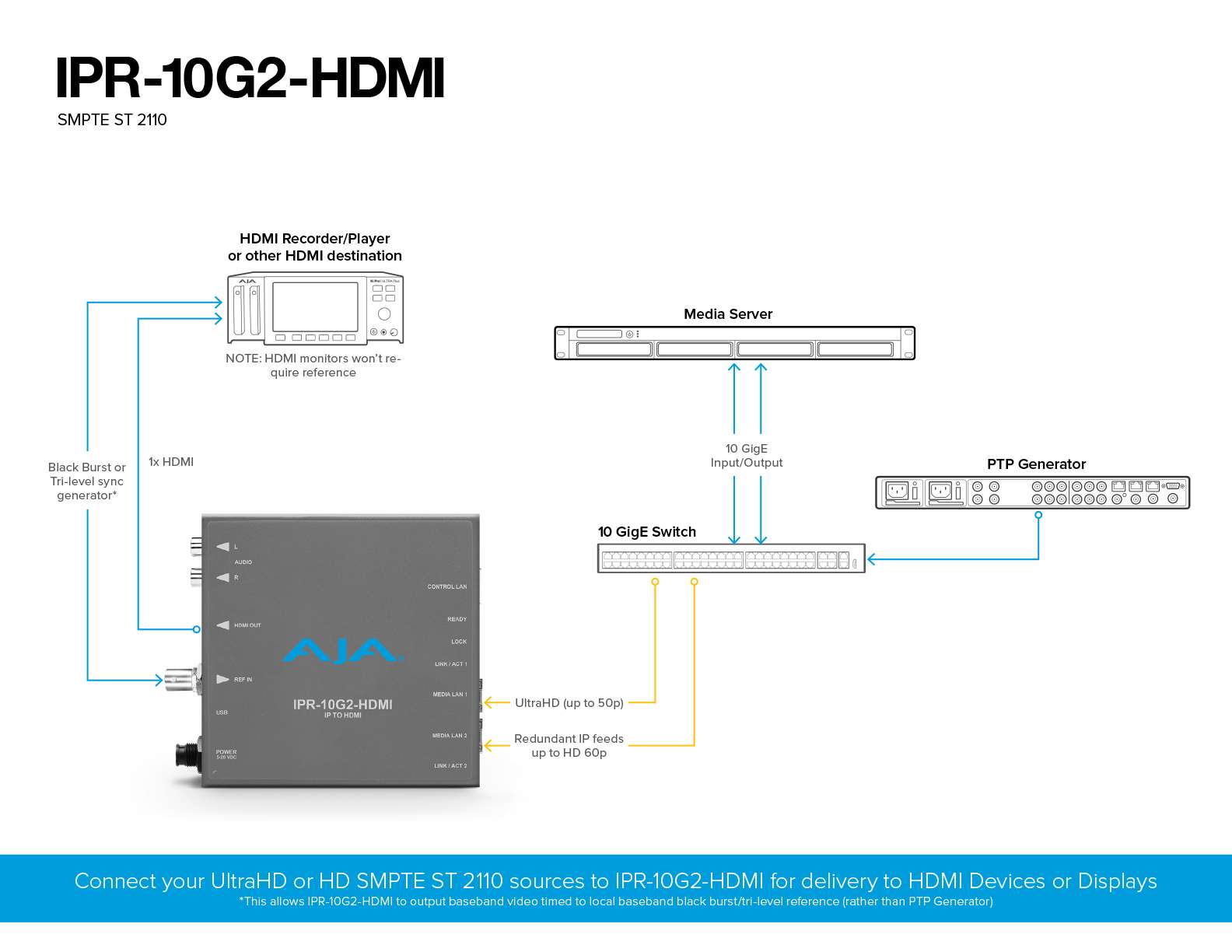
- IPR-10G2-HDMI: Receives ST 2110 over 10 GbE, outputs full-size HDMI up to UltraHD 50p or HD 60p
- IPT-10G2-HDMI: Encapsulates HDMI HD sources and transmits them as ST 2110 over 10 GbE
- Both feature dual SFP+ cages for ST 2022-7 hitless switching protection
- Compact, fanless, rugged design — mountable behind monitors, in racks, or on camera rigs
- Ideal for: HDMI source integration, confidence monitoring, hybrid production environments
Matrox Video — ST 2110 & IPMX Products
Matrox Video has been at the forefront of broadcast and professional AV technology for over four decades. Their SMPTE ST 2110 and IPMX product portfolio spans IP KVM extension, signal conversion, and network diagnostics — all built on open standards and designed to integrate seamlessly into modern IP infrastructures.
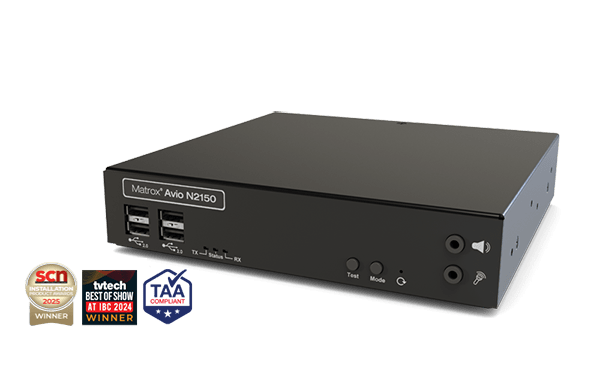
The Matrox Avio N2150 IP KVM extender delivers secure and real-time remote access to mission-critical systems, ensuring outstanding image quality with support for resolutions up to 4K. Built on open standards including IPMX, SMPTE ST 2110, and NMOS, Avio 2 is a future-ready solution that combines flexibility, scalability, and ease of use. Designed to integrate seamlessly into modern networked infrastructures, it is the perfect choice for control rooms, medical environments, broadcast studios, media production, and live event operations.
- World's first IPMX / SMPTE ST 2110-based IP KVM extender — a true industry first
- 4K resolution support with outstanding image quality and real-time responsiveness
- Built on open standards: IPMX, SMPTE 2110, and NMOS for maximum interoperability
- Secure remote access to mission-critical systems — ideal for sensitive environments
- Seamless integration into modern networked IP infrastructures without proprietary lock-in
- Flexible and scalable architecture that grows with your facility's needs
- Designed for: control rooms, medical environments, broadcast studios, media production, and live event operations
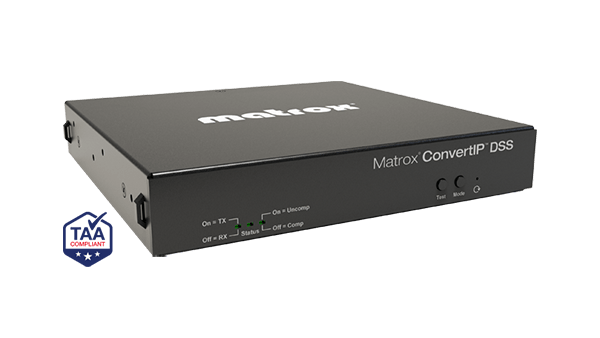
- Purpose-built for interoperable, scalable IP video production, monitoring, and routing
- Full NMOS support for discovery and connection management across the IP ecosystem
- Daisy Chain feature enables flexible, redundant distribution from a single network port
- Available in multiple configurations: DRH, DSH, DRS, DSS, SRH, SRS, SRST, SDM
- Matrox ConductIP routing software provides a unified control surface for all NMOS-enabled ST 2110 and IPMX devices
- Ideal for: live production, broadcast monitoring, AV signal routing, hybrid IP/SDI environments
Why Partner with Mediasys for Your ST 2110 Journey?
Deploying SMPTE ST 2110 is not simply a matter of purchasing hardware — it requires careful network design, PTP clock architecture, NMOS configuration, and a thorough understanding of how IP and broadcast workflows interact. Mediasys has spent over two decades building deep technical expertise across the AJA and Matrox product portfolios, working with broadcasters, post-production facilities, live event producers, and systems integrators across the Middle East.
Whether you are taking your first steps into IP production with a hybrid ST 2110 / SDI setup, or planning a full greenfield IP facility, our team can advise on the right combination of hardware, help you design a network topology that meets SMPTE requirements, and provide post-sales support in the region.
Frequently Asked Questions
-
No. Many facilities begin with a hybrid approach, using ST 2110 for new installations and IP gateway products — like the AJA IP25-R or Matrox ConvertIP — to bridge between existing SDI equipment and the new IP network. This allows a phased migration that protects existing investments while building toward a fully IP infrastructure over time.
-
ST 2110 requires a managed Ethernet network with PTP-capable switches and a Grandmaster Clock for synchronisation. For uncompressed 4K workflows, 25 GbE or 100 GbE links are recommended. Standard IT switches from vendors such as Arista, Cisco, and Mellanox are widely used in ST 2110 environments.
-
NMOS (Networked Media Open Specifications) provides open APIs that enable ST 2110 devices to discover each other and be connected through software. While technically optional, NMOS is strongly recommended for any scalable installation because it dramatically simplifies signal routing and device management. All major AJA and Matrox ST 2110 products include NMOS IS-04 and IS-05 support.
-
Yes, particularly when combined with ST 2110-22 and JPEG XS compression for contribution links. Many broadcasters are using ST 2110 as the backbone for REMI (Remote Integration Model) production workflows, where camera signals originate at remote venues and are produced centrally over IP connections.
-
The KONA IP operates over 10 GbE and supports ST 2110 up to 4K alongside ST 2022-6. The KONA IP25 is the next-generation card, operating over dual 10/25 GbE connections on a PCIe Gen 4.0 bus, supporting higher-density uncompressed 4K/UHD workflows with a more capable on-board NMOS and PTP implementation.