IPMX: The Open AV over IP Standard Every Integrator Needs to Know in 2026
A complete guide to IPMX — what it is, why it matters for AV integrators, and the Matrox hardware that brings it to life in production environments today.
The professional AV industry has been navigating a fragmented IP landscape for years — proprietary protocols, closed ecosystems, and interoperability headaches that slow down installations and inflate costs. That is about to change. IPMX, the Interoperable Pro Media Experience standard, is the first truly open AV over IP standard designed specifically for professional AV environments. For integrators and installers, understanding IPMX now is not optional — it is a competitive advantage.
What Is IPMX? A Technical Overview for AV Professionals
IPMX is a comprehensive suite of open standards and specifications for transporting professional audiovisual content over IP networks. It does not reinvent the wheel. Instead, it intelligently layers proven broadcast technologies with pro AV-specific additions to create a complete, deployable standard.
IPMX is built on four core specifications:
Together, these specifications create an end-to-end architecture that handles media transport, synchronisation, control, copy protection, and device management within a single interoperable framework.
Why IPMX Matters for AV Integrators
True Interoperability Across Manufacturers
The biggest pain point for integrators in AV over IP has always been vendor lock-in. Proprietary protocols force you to spec within a single ecosystem or manage complex bridging solutions that add cost and failure points. IPMX changes this fundamentally. Because the standard originates from a collaboration between AIMS, JT-NM, VSF, AMWA, EBU, and SMPTE — all independent non-profit organisations — it carries no commercial allegiance to any single vendor. You can mix and match hardware and software from different manufacturers with confidence they will interoperate natively, out of the box.
Auto Device Discovery Simplifies Commissioning
IPMX leverages AMWA NMOS IS-04 and IS-05 for automatic device discovery, registration, and connection management — conceptually similar to how a network printer is found on a LAN. Devices announce themselves to the network, register with a discovery server, and become immediately available for connection management with no manual IP mapping tables and no complex handshaking configurations. For large-scale installations with dozens or hundreds of endpoints, this translates directly into fewer billable hours and faster project delivery.
Runs on Commercial Off-the-Shelf (COTS) Network Infrastructure
IPMX is designed to operate on standard Ethernet infrastructure — the same switches and routers already deployed in enterprise environments. There is no requirement for proprietary network hardware. The standard supports 1G, 10G, and 25G+ network topologies, giving integrators the flexibility to design infrastructure appropriate for the project's budget without forcing unnecessary over-engineering.
JPEG XS: Broadcast-Quality Compression at Practical Bitrates
One of IPMX's most important technical contributions to pro AV is the adoption of JPEG XS as its primary compression codec. JPEG XS is a visually lossless, low-complexity compression format that achieves sub-millisecond encode/decode latency. It delivers broadcast-quality 4K60 4:4:4 streams at bitrates compatible with a standard 1-Gigabit network connection — premium image quality without premium network costs.
Sub-Frame Latency with PTP Time Synchronisation
IPMX uses Precision Time Protocol (PTP) as defined in SMPTE ST 2110 to synchronise all devices on the network to a common clock reference. This enables sub-frame latency across the entire signal chain — a critical requirement for live event production, broadcast contribution, and interactive AV applications where lip sync accuracy and frame-precise timing are non-negotiable.
HDCP Support for Copy-Protected Content
IPMX includes provisions for interoperable HDCP (High-bandwidth Digital Content Protection) — a mandatory requirement for any installation handling premium commercial content. This covers corporate boardrooms, entertainment venues, hospitality, and digital signage deployments where content licensing demands copy protection compliance.
USB and Interactive Feature Extensions
Beyond audio and video transport, IPMX includes specifications for USB over IP, enabling interactive peripheral sharing across the network. Cameras, headsets, and input devices can be routed and managed over the same IP infrastructure as the AV streams — reducing cable runs, minimising rack space, and simplifying the overall system architecture into a single unified network layer.
Use Cases Where IPMX Delivers Immediate Value
Who Is Behind IPMX?

IPMX was initiated by the Alliance for IP Media Solutions (AIMS) and developed collaboratively through the Joint Taskforce on Network Media (JT-NM), a federation of four independent standards organisations:
Every organisation involved is an independent non-profit without commercial ties to any manufacturer. The specifications are intended to be available to manufacturers and integrators at low or no cost — removing licensing barriers to adoption. This governance model ensures that IPMX will remain open, vendor-neutral, and free from proprietary control over the long term.
Preparing Your Practice for IPMX
For integrators, practical preparation for IPMX adoption centres on three areas:
IPMX in Action: Matrox Solutions Built on the Standard
Understanding IPMX as a specification is one thing — seeing it deployed in production-grade hardware is another. Matrox Video is one of the leading manufacturers actively building IPMX-compliant products for pro AV and broadcast workflows. For integrators evaluating IPMX-ready equipment today, two Matrox product lines stand out as strong reference implementations of the standard.
Matrox Video has been at the forefront of broadcast and professional AV technology for over four decades. Their IPMX and SMPTE ST 2110 product portfolio — available through Mediasys across the Middle East — delivers production-ready, open-standards-based performance from day one.
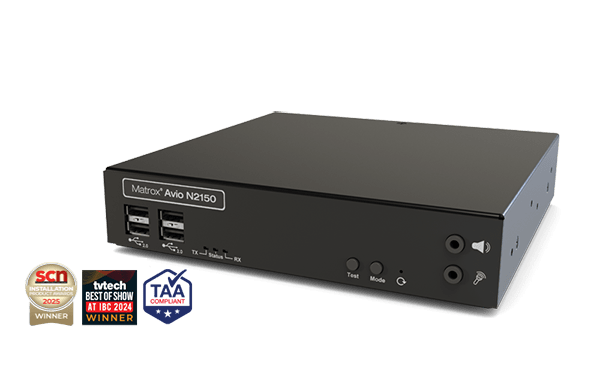
The Matrox Avio N2150 is widely recognised as the world's first IP KVM extender built natively on open standards — IPMX, SMPTE ST 2110, and NMOS. Designed for mission-critical environments requiring secure, real-time remote access to computing equipment, it is the perfect choice for control rooms, broadcast studios, medical facilities, and live event production.
- Video Performance: Uncompressed 4Kp60 4:4:4 over dual 10GbE with zero latency, or visually lossless JPEG XS over 1GbE — compatible with both high-performance and bandwidth-constrained network environments.
- IPMX / ST 2110 Compliance: Full IPMX and SMPTE ST 2110 compatibility with NMOS open APIs for device discovery, connection management, and third-party controller integration.
- Flexible Deployment: Configurable as transmitter or receiver, supporting 1-to-many, many-to-1, and many-to-many topologies. Fiber or copper via 1G/10G SFP with optional PoE+ RJ45. ST 2022-7 network redundancy.
- Security Architecture: AES 128-bit encryption across all A/V and USB signals. Microsoft Active Directory integration, HTTPS support. TAA-compliant model available for government and secure facility deployments.
- Full KVMA: Keyboard, video, mouse, and audio routing over IP for collaborative workflows — multiple users sharing a single computer, or single-operator multi-system access.
- Designed for: control rooms, medical environments, broadcast studios, media production, and live event operations.
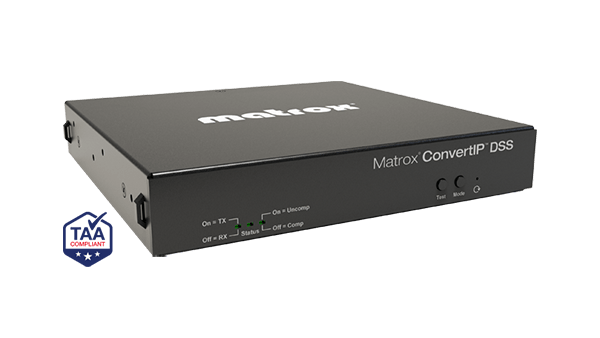
The Matrox ConvertIP Series is a family of compact, standalone IPMX/ST 2110 baseband converters, encoders, and decoders designed to bridge existing SDI, HDMI, and HDBaseT signal infrastructures with IP networks. For integrators managing hybrid environments, ConvertIP provides the conversion layer that makes the transition practical without forcing a full system replacement.
Available Models:
-
ConvertIP DRHCompact HDMI encoder/decoder with three RJ45 ports for 1G AV workflows. Zero-latency HDMI loop-out for real-time local monitoring alongside IP transport.
-
ConvertIP DRSSDI encoder/decoder with 12G-SDI, genlock, and three RJ45 ports. PTP-derived genlock output synchronises SDI devices such as PTZ cameras across the IP network.
-
ConvertIP DSHHDMI transmitter/receiver with IP video gateway for converting between uncompressed and compressed SMPTE ST 2110 and IPMX signals. Two SFP28 ports for 10G/25G. Supports Daisy Chain.
-
ConvertIP DSSSDI transmitter/receiver with 12G-SDI, genlock, two SFP28 ports. Compressed or uncompressed up to 25G. Built-in ST 2022-7 redundancy for mission-critical deployments.
-
ConvertIP SRSCompact 1G/2.5G SDI transmitter/receiver supporting 4K60 over a single RJ45 port. PoE+-powered with optional redundant power supply.
- ProAV and JPEG XS compression alongside fully uncompressed transport modes on every unit
- Fanless, PoE+-powered, and configurable as TX or RX — single SKU for both encode and decode
- Daisy Chain feature drives multiple displays from a single switch port, reducing SFP count, fiber runs, and TCO on high-density monitor wall and signage deployments
- Full IPMX/ST 2110 compatibility and NMOS open API support on all models
- ConvertIP Manager software centralises installation, firmware updates, routing configuration, and monitoring across all units
- Ideal for: live production, broadcast monitoring, AV signal routing, hybrid IP/SDI environments
Frequently Asked Questions About IPMX
-
IPMX stands for Internet Protocol Media Experience. It is a suite of open standards and specifications developed to enable interoperable professional AV over IP, built upon SMPTE ST 2110, AES67, AMWA NMOS, and the VSF TR-10 series.
-
Unlike proprietary AV over IP protocols, IPMX is a fully open standard developed and governed by independent non-profit organisations — AIMS, VSF, AMWA, EBU, and SMPTE — with no commercial allegiance to any single manufacturer. Any manufacturer can build IPMX-compliant products that interoperate natively with other IPMX devices, without licensing fees, bridging hardware, or vendor-specific configuration. Proprietary protocols, by design, restrict that cross-manufacturer interoperability.
-
No. IPMX is designed to run on standard commercial off-the-shelf (COTS) Ethernet infrastructure. Standard managed switches with IGMP multicast support and PTP grandmaster capability are sufficient for most deployments. IPMX supports 1G, 10G, and 25G+ network topologies, so existing enterprise networking hardware is typically compatible.
-
Yes. IPMX uses the JPEG XS codec to deliver visually lossless 4K60 4:4:4 video over a standard 1-Gigabit network connection. This is one of the key practical advantages of IPMX for pro AV deployments — premium video quality without requiring a 10G network upgrade.
-
IPMX uses Precision Time Protocol (PTP) for device synchronisation as defined in SMPTE ST 2110, enabling sub-frame latency across the full signal chain. For compressed JPEG XS streams, encode/decode latency is sub-millisecond, making IPMX suitable for latency-sensitive applications including live production, IMAG, and interactive conferencing.
-
Yes. IPMX includes provisions for interoperable HDCP (High-bandwidth Digital Content Protection), enabling compliant transport of copy-protected content over IP. This makes IPMX applicable to installations in corporate boardrooms, entertainment venues, hospitality, and digital signage environments where HDCP compliance is a contractual or technical requirement.
-
NMOS (Networked Media Open Specifications) is the control plane of IPMX. It handles automatic device discovery (IS-04) and connection management (IS-05), allowing IPMX devices to find each other on the network and connect without manual configuration. For integrators, NMOS is what makes IPMX installations dramatically faster to commission compared to proprietary systems that require manual IP assignment and signal mapping.
-
Yes. IPMX is built on SMPTE ST 2110, the standard already widely deployed in professional broadcast infrastructure. Its sub-frame latency, PTP synchronisation, support for uncompressed and JPEG XS compressed streams, and multi-channel AES67 audio make it technically appropriate for live event, broadcast contribution, IMAG, and rental-staging workflows.
-
Yes. Manufacturers including Matrox Video have shipping IPMX-compliant products. The Matrox Avio N2150 (Avio 2) and Matrox ConvertIP Series are production-ready examples of IPMX hardware available through Mediasys in the Middle East. The IPMX ecosystem is actively growing as more manufacturers bring certified products to market.
-
IPMX deployments require competency in IP network fundamentals: IGMP multicast configuration, PTP grandmaster setup and boundary clock design, QoS policies for time-sensitive streams, and familiarity with NMOS IS-04 and IS-05. Integrators already experienced in Dante, AVB, or SDVoE network design will find the transition manageable with targeted upskilling in SMPTE ST 2110 and NMOS.
-
Yes. IPMX specifications are available at low or no cost, as the standard is governed by independent non-profit organisations committed to open, royalty-free access. There are no licensing fees for manufacturers building IPMX-compliant products or integrators deploying them.