SMPTE ST 2110 & IPMX Baseband Converters, Encoders & Decoders
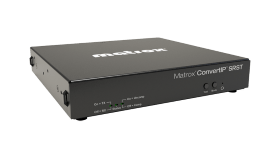
Matrox ConvertIP is a professional series of SMPTE ST 2110 and IPMX baseband converters, encoders, and decoders designed for modern AV over IP workflows. ConvertIP seamlessly converts SMPTE 2110 and IPMX IP signals to and from HDMI, HDBaseT™, and SDI, supporting both uncompressed and compressed AV over IP signal formats.
Each ConvertIP device is fully configurable as either a transmitter (TX) or receiver (RX), enabling you to display, monitor, and transmit 4K video signals with zero latency across 1G to 25G networks. Whether deploying over copper or fiber infrastructure, ConvertIP delivers the flexibility and performance demanded by broadcast, pro AV, and enterprise environments.
The converters support multiple codecs — including ProAV and JPEG-XS — for visually lossless compressed and fully lossless uncompressed video transmission, ensuring pristine image quality at every point in the signal chain.
Managing large deployments is effortless with the included ConvertIP Manager software, which centralizes multi-unit installation, firmware updates, signal routing, and system configuration in one intuitive interface.
Perfect video synchronization
Zero latency with lossless 4K image quality
Convenient web-based user interface for configuring ConvertIP devices
IPMX, SMPTE ST 2110, and NMOS aware
Flexible media network connectivity (support for 10/25G SFPs)
Supports Compressed and Uncompressed
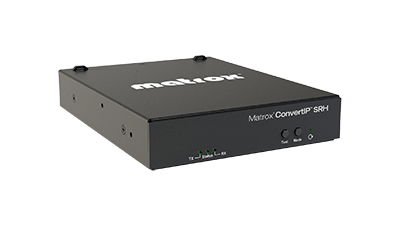
ConvertIP SRH
Matrox ConvertIP SRH is capable of receiving or transmitting ST 2110 or IPMX signals, and features one RJ45 port.
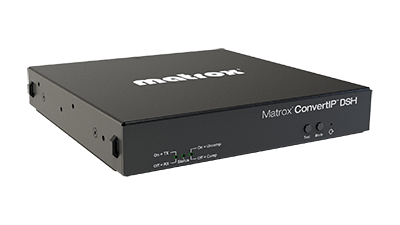
Matrox ConvertIP DSH is capable of receiving or transmitting ST 2110 or IPMX signals, and features HDMI I/O, one RJ45, and two SFP28 ports on a single device.
Matrox ConvertIP DRS is capable of receiving or transmitting ST 2110 or IPMX signals, and features 12G-SDI, genlock, and three RJ45 ports on a single device.
Matrox ConvertIP DSS is capable of receiving or transmitting ST 2110 or IPMX signals, and features 12G-SDI, genlock, one RJ45, and two SFP28 ports on a single device.
IPMX (Internet Protocol Media Experience) is an open standard developed by the AIMS Alliance and SMPTE for transporting professional audio, video, and data signals over standard IP networks. Built on top of SMPTE ST 2110 and a collection of complementary standards, IPMX extends IP media transport beyond traditional broadcast environments into the wider pro AV world — including corporate, education, digital signage, and live event applications. Unlike ST 2110, which is primarily designed for uncompressed broadcast studio workflows, IPMX also supports compressed formats like JPEG-XS, making it practical for deployment across standard 1G, 10G, and 25G IT network infrastructure. In essence, IPMX bridges the gap between broadcast-grade signal quality and the flexibility of modern IT networks, enabling seamless interoperability between AV and IP ecosystems.
What is ST2110?
SMPTE ST 2110 is a suite of professional broadcast standards developed by the Society of Motion Picture and Television Engineers (SMPTE) that defines how to transport uncompressed video, audio, and ancillary data as separate streams over standard IP networks. Before ST 2110, broadcasters relied heavily on traditional SDI (Serial Digital Interface) cables to carry video signals, but as IP networking became more powerful and cost-effective, the industry needed a standardized way to move broadcast-grade signals across IP infrastructure without compromising quality. ST 2110 solved this by breaking the traditional SDI signal into individual essences — video, audio, and metadata — each travelling as its own IP stream, giving broadcasters far greater flexibility, scalability, and control over their signal routing. Widely adopted across broadcast studios, live production, and media facilities worldwide, ST 2110 is considered the backbone of modern IP broadcast infrastructure, and is the foundation upon which newer standards like IPMX are built.